

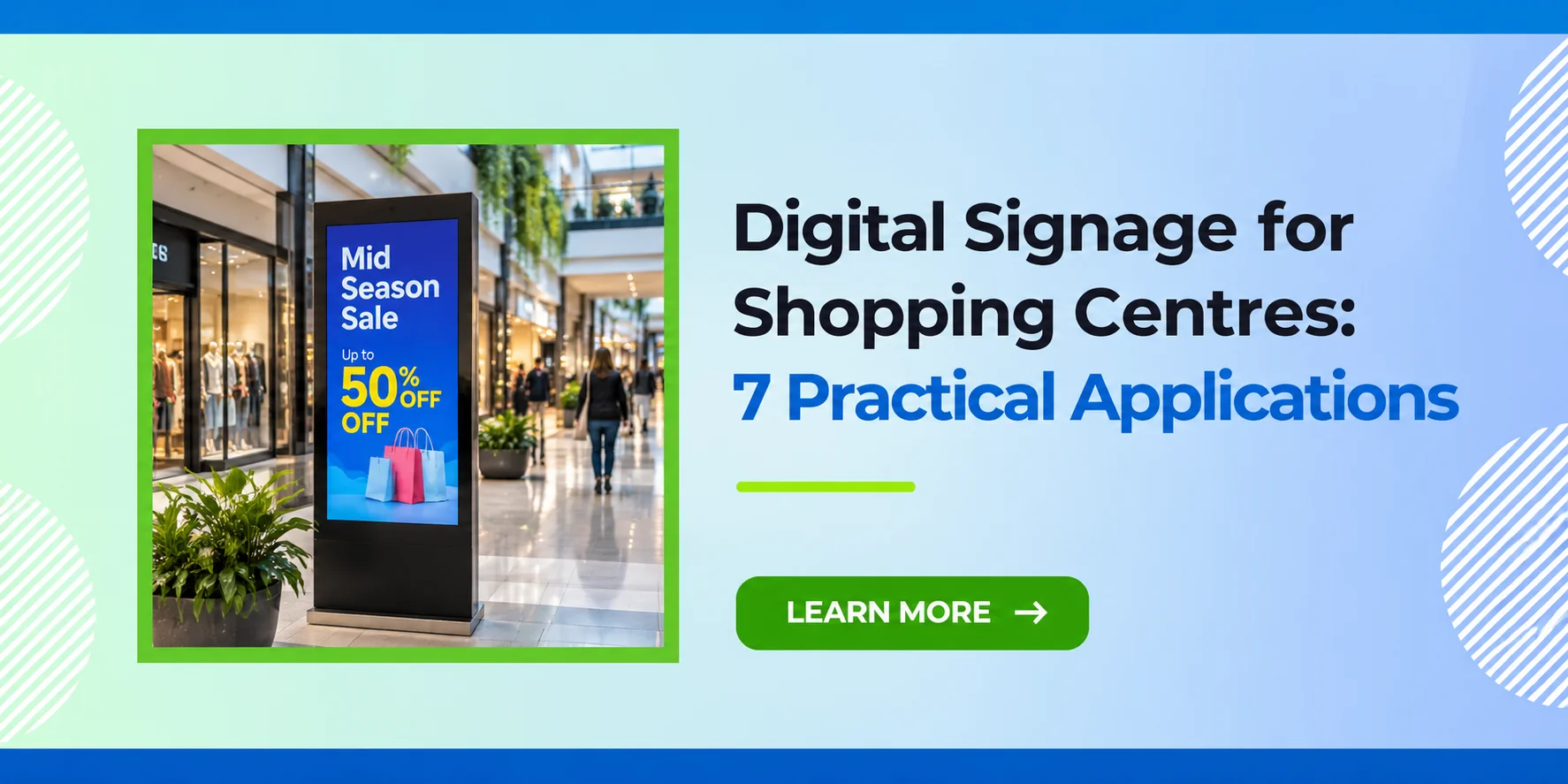
06 Nov Digital Signage for Shopping Centres: 7 Practical Applications
Look around any big shopping centre and you’ll see thousands of people, all on their own missions. Some are heading straight for a specific store. Others wander aimlessly, looking for friends, food or a way out.For shopping centre managers, contacting so many different people at the same time is never easy.Posters by the entrance are easily ignored.
Printed directories become out of date and complicated when multiple stores run promotions at the same time.Shopping centres have many ways to keep visitors informed, but not every digital sign has to advertise. In fact, the most useful applications of digital signage in shopping centres are simple and creative.Here are seven of those applications.
1. Digital directories
Large shopping centres with hundreds of stores can be confusing for new visitors. Traditional directories do not provide information about store locations, services or floors. They also become out-of-date when stores relocate, close or change.Interactive digital directories can show all store locations and can be easily updated.
2. Wayfinding
A digital directory placed near the entrance can help visitors locate stores, services and facilities including ATMs, parent rooms, family rooms and first aid.The directory can also show which floor they need to visit.For large shopping centres, directories may include:Store locations and categoriesToilets, lifts and accessible entrances; food courts and customer service desksParking entrances and exitsThe goal is to keep the pathway as simple as possible. Shoppers shouldn’t need to go through multiple steps to find a store.
Placement tip: Place wayfinding displays at main entrances, lift lobbies and major pathway intersections where visitors naturally pause to decide where to go next.
3. Give retail promotions more visibility
For a clothing retailer with a Friday morning sale, the marketing team would need to arrange for printed posters to be made, delivered and installed. If the sale ends, they need to do it all again to promote the next sale.An advertising screen would allow the marketing team to schedule promotions and change them at will, without needing to swap out posters.Shopping centres can use advertising screens to promote tenant retail offers, campaigns and new store openings.Avoid a common mistake: too many, unclear advertisements on a short rotation.
A confusing advertisement will not communicate much to a visitor if they only have a few seconds to see it.For advertisements with a lot of information, use clear, simple design and an easy to understand image.
Placement tip: Place displays in high traffic areas such as main walkways, and near store clusters, and avoid placing displays in ways that obstruct customer movement.
4. Make food court menus easier to update
Food courts are very busy around lunch time.Customers are interested in three things: what is offered, how much does it cost, and are there any specials? They don't want to try to decipher a cluttered menu while standing in line.Food outlets use digital menu boards to sell their products. For example, a café might sell breakfast in the morning and switch to selling lunch in the afternoon. A restaurant might remove, price, or highlight a meal.
Menu board design can help with readability.Signs should have distinct categories, and fonts should be large enough to read from the serving line. Prices should contrast backgrounds to help readability.Menus should not be complicated and animated. The focus should be on reducing customer confusion.
5. Keep visitors informed about events and activities
There are many activities at shopping centres besides shopping. For example, many centers offer activities for children during the school holidays. Others host seasonal fairs or art exhibitions. Digital signage can help customers locate center activities. For example, digital signs can help customers find where a children's activity is located and when they should arrive to register. After the activity, the digital signage can be changed to help customers locate the next activity.
This is ideal for shopping centres that host many different activities. Digital signage gives shopping centre managers another method for communicating center activities to customers besides traditional printed notices or social media.
6. Place important operational and safety information
Not all messages need to be aimed at increasing purchases.Shopping centre managers require a quick way to distribute important information to visitors.A temporary shut-down of a particular lift may require communication to visitors. An ongoing maintenance work may have affected a corridor.
A particular centre entrance may be closed off for repairs.Digital displays may be utilized for such communications.With centralized control, an authorized staff member may update information on displays as required without the need for a staff member to move physically to each location to post notices.
6. Improve communication in car parks and entrances
The customer experience begins when the visitor pulls into the shopping centre’s car park.Shopping centre planners often ignore car parks when considering digital signage.However, in plazas, car parks and pedways, the communicate practical information such as temporary changes to access points or parking instructions.
At entrances, digital signage can inform visitors about changes in centre operating hours and public holidays, and to let visitors know about changes in centre tenants.Outdoor signage is more complex.Direct sunlight may wash out an image that is very readable indoors.To increase readability in outdoors, other factors such as mounting position and distance needs to be considered.
When using LED signage for New Zealand shopping centres, planners need to consider the local environment and ensure that signage is installed appropriately.Some digital signage platforms support integration with emergency communication systems, but this varies based on the specific installation and configuration of the system.It is important to note that digital signage systems are intended to supplement, not replace, required emergency signage, audible alarms, and established safety and building procedures.Used properly, digital displays can help make routine building operational updates more visible and effective.
7. Create a more welcoming shopping environment
The atmosphere of a shopping center is impacted by many things, including the design of the center, security and safety features, the location of restrooms, merchandise delivery areas, and of course the shops and services.Displays can be installed in the common areas to show signs and graphics to reinforce the center's safety and security policies. Other displays can be used to showcase local artwork, seasonal events or displays to promote the center and encourage community participation.
There doesn't always need to be a direct sales message to accomplish these goals.Sometimes, the goal is simply to integrate more welcoming and current displays.Of course, screen size alone does not always guarantee a positive outcome.There needs to be an integration of the technology with the architecture of the space and the surrounding displays. Content must also be designed for the space rather than distract or detract from it.
What should shopping centers take into account when using digital signage?
The seven examples listed above may seem simple, but a lot of planning needs to occur before a signage installation can be successful.Before committing to a signage display, there are a few things that shopping center operators should take into consideration.
Who will be viewing the screen?
The message on a display in a corridor will be different from the message on a display in a seating area. For a display in a seating area, messages can be longer and more detailed, but a display in a corridor will only be viewed for a short time.
How long will people need to view the message?
Messages can be shorter in a busy walkway, but a message that requires more detail can be placed in a seating area.
Where will the screen be placed, indoors or outdoors?
There are differences in technology and durability between displays placed indoors and displays placed outdoors. Displays outdoors will need to be brighter to be visible in direct sunlight.
How will the content be managed?
The management system needs to support an appropriate workflow if many retailers need to access the system.
What will happen after the display is installed?
Responsibility for updating and maintaining the display should be clearly communicated. There are accessible pedestrian ways (APWs) located within shopping malls that allow people to view the displays and their messages, but there are limitations on the types of equipment that can be plugged into APWs. Before any equipment is installed, there are building approvals that may apply.There are many technologies available for different display needs. Shopping centers in New Zealand need the right digital signage for their unique business needs.
The best option depends on the shopping center and what the center wants the displays to do. Businesses should evaluate the total cost of ownership including equipment, installation, ongoing support, management and use of the system.WiPath Communications partners with organisations in New Zealand for digital display and LED signage projects, from system selection to installation, based on the requirements of various commercial environments.
Final Thoughts
Not all digital signage makes a shopping centre more engaging or helps people navigate it.Useful signage serves a purpose, and that's what matters.A directory helps someone find a store. A display that promotes an offer should do so clearly. A screen that provides information should answer a question a visitor may have.Digital signage that is planned to help people fulfill their everyday needs becomes part of the communication between a shopping centre and its visitors.
Sorry, the comment form is closed at this time.