

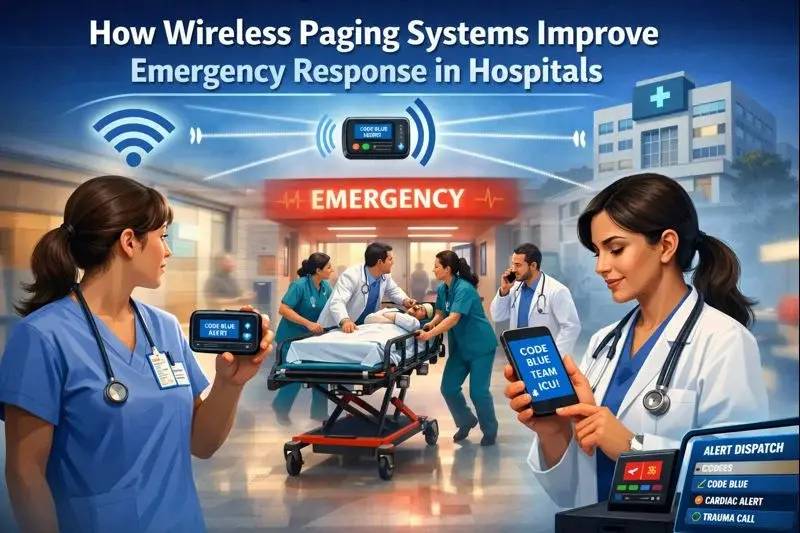
29 Jan How Wireless Paging Systems Improve Emergency Response in Hospitals
Hospital Emergencies are Unpredictable, and can occur at any time. The cases of a cardiac arrest, a critical illness, a severe change in the conditions of a patient, or a significant event may take place at any moment. In this case, it is not optional but rather mandatory to use swift and dependable communication. The skill of communicating with the appropriate medical practitioners as quickly as possible can help to save one’s life.
Although the development of smartphones, messaging applications, and online platforms has happened,yet wireless paging systems remain an important part of hospital emergency response. In fact, modern paging systems have become highly reliable, focused, and purpose-built for the healthcare environment.
In this article, we will discuss application of wireless paging systems in enhancing emergency response at hospitals and how they have contributed to response time, coordination of staffs, patient safety, and operational resilience.
1. Speed is the main thing in Hospital
Time is among the most important factors that affect clinical care outcomes. The so-called golden minutes are often mentioned by medical specialists in the emergencies of cardiac arrest, stroke, or severe trauma. Any delay in communicating with the relevant response team may lead to severe complications, delay recovery or even death.
Traditional communication methods — such as overhead announcements, fixed nurse stations, or telephone calls — introduce delays and uncertainty. Staff may be away from their desks, calls may go unanswered, or messages may be misinterpreted. Wireless paging systems address these challenges by delivering alerts directly to individuals, wherever they are within the hospital.
2. Why Wireless Paging Systems Are Best For Hospitals
Hospitals are enclosed areas with walls, more than one floor, high level of activities and people are constantly in motion. Under these circumstances, the communication systems should be dependable and reliable. Paging systems that are wireless are designed to work in such environments and have a number of benefits:
- Specialized radio frequency penetrative of hospital infrastructure than mobile signals.
• Self-reliance without Wi-Fi or mobile network which can get overloaded in times of emergency.
• Outstanding battery life, such that devices can continue working during extended shifts.
• Minimalist and concentrated functionality, less distracting than smartphones.
These features render wireless paging systems particularly reliable in cases of emergency where other technologies will either fail or slow down.
3. Reducing Emergency Response Times
The ability to dramatically reduce the response time is one of the most important advantages of it. In the case of an emergency, it is possible to notify all the necessary responders, doctors, nurses, specialists, and support staff in time without delays.
For example:
- When there is a Code Blue, various clinicians should come to rescue. Paging systems take care of informing the whole response team at the same time.
• In trauma cases, anaesthetists, radiology staff and surgical teams can be notified of the patient first.
• Patient deterioration can also be detected early before the situation aggravates.
Paging systems remove the manual message relay process or frequent calls that would lead to inefficiency in emergency communication and prompt delivery of care.
4. Targeted and Prioritised Emergency Alerts
The modern wireless paging systems are much more developed than the traditional beepers. They favour prioritisation and targeting of messages based on roles, so that urgent messages are attended to.
Key capabilities include:
- Life threatening emergencies priority alerts.
- Role-relevant messaging, which means that only the relevant staff is informed.
- Escalation procedures, which necessitate sending alerts again in case they are not responded to.
- Dumb notifications, which curb unwarranted noise in sensitive zones.
This accuracy is critical in avoiding alarm fatigue that is a frequent problem in hospitals whereby too many non-urgent alarms may de-sensitize staff. Wireless paging will make sure that emergency messages are highlighted and immediate response is taken.
5. Integration with Nurse Call and Clinical Systems
The nurse call systems, patient monitoring devices, and emergency sensors are frequently combined with wireless paging systems. The integration increases situational awareness and enhances the quality of response.
For example:
- When a patient pushes a nurse call button, he will cause an immediate page to the nurse assigned to him.
• The fall detection sensors can notify the staff instantly in case a patient is in danger.
• The important equipment alerts can inform the technical teams in real-time.
The paging systems are able to provide the facility to issue alerts to respective hospital workers even when they are out of their terminal in case of an emergency.
6. Reliability During Critical Events
Crises or sudden accidents can happen anytime and in this scenario the standard communication tools can be damaged because of power outages, network overload, or due to system overloading, that’s where wireless paging systems are built in a resilient manner.
Their advantages include:
- It will continue to operate even in case of network failures.
• Constant operation in high traffic settings.
• It was tested and proven to be reliable in large scale incidents and pandemics.
The reason why hospitals across the world use paging systems in times of crisis is because the system will be available when the rest of the systems are crashed.
7. Improved Staff Coordination Across Departments
The process of responding to an emergency needs to be coordinated on a departmental level. It enables everyone concerned with the system to obtain information in a consistent and real-time manner.
This results in:
- Improved coordination between clinical and support personnel.
• Less confusion in the process of emergency.
• Quickened utilisation of resources like beds, equipment and transport.
Immediate, clear communication of the information to the staff members makes such an emergency response more organized and effective.
8. Enhancing Patient Safety and Experience
While the primary purpose of paging systems is operational efficiency, they also have a direct impact on patient safety and experience.
Patients and families benefit from knowing that staff can be summoned quickly without delays or disruption.
In the long term, improved emergency communication contributes to higher standards of care and greater trust in healthcare services.
Why Hospitals Choose WiPath Communications Ltd
At WiPath Communications Ltd, we provide reliable, scalable wireless paging solutions tailored to healthcare environments. Our systems are designed to support fast emergency response, seamless staff coordination, and long-term operational reliability.
We work closely with healthcare facilities to:
- Assess communication challenges
• Deploy robust paging solutions
• Support integration with existing systems
• Ensure long-term performance and scalability
Sorry, the comment form is closed at this time.